
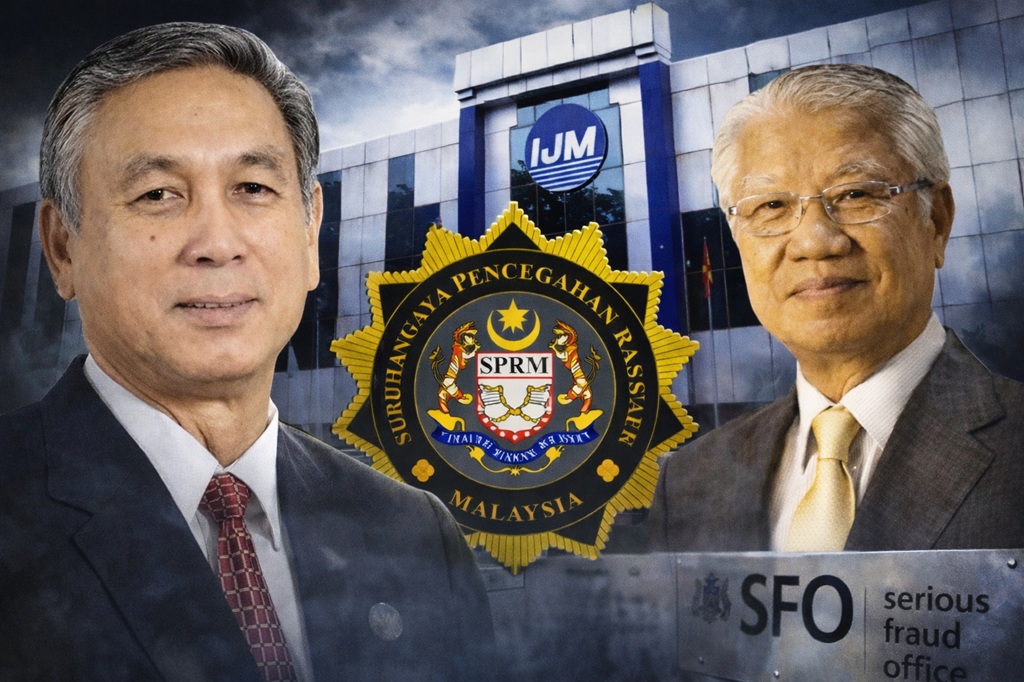
KUALA LUMPUR — What was once dismissed as an online whistleblower exposé published by a Britain-based business intelligence portal has now escalated into one of Malaysia’s most serious corporate scandals in recent years.
Malaysia’s anti-graft agency has formally launched an investigation into IJM Corporation Berhad, probing alleged money-laundering activities involving sums estimated at RM2.5 billion — approximately £487 million (US$617 million). At the centre of the investigation are IJM chairman Tan Sri Krishnan Tan and his long-time associate and alleged proxy, Seow Lun Hoo @ Seow Wah Chong.
The development appears to validate earlier explosive reports by Britain Business Insider, which alleged the existence of extensive offshore financial structures, opaque proxy arrangements and cross-border fund flows inconsistent with declared income and tax records.
MACC Confirms Probe as Shares Slide
The Malaysian Anti-Corruption Commission (MACC) confirmed that investigations are under way, with Chief Commissioner Tan Sr i Azam Baki stating that further details would be disclosed “from time to time”.
Officers from MACC and the Inland Revenue Board (LHDN) were seen at IJM’s headquarters on 19 January, officially described by the company as a visit to “obtain information”.
Markets reacted swiftly. IJM shares fell 5.7% to RM2.50 at opening, down from RM2.65, after plunging as much as 16.4% the previous day — wiping out hundreds of millions of ringgit in market value.
From Whistleblower Letter to Criminal Probe
According to documents reviewed by foreign journalists, the scandal traces back to a detailed whistleblower complaint addressed to Bank Negara Malaysia (BNM) and copied to the Attorney General’s Chambers. The complaint named Krishnan Tan and Seow Lun Hoo, alleging:
- Undeclared or inadequately explained offshore accounts
- Proxy-held assets and layered transfers
- Income and tax declarations grossly inconsistent with asset size
The whistleblower questioned governance oversight at institutional shareholders, including Permodalan Nasional Berhad (PNB), and alleged regulatory inaction despite red flags recorded in financial intelligence reports.
Krishnan Tan: Offshore Wealth, Limited Transparency
Central to the allegations is the claim that Tan Sri Krishnan Tan controls offshore accounts totalling approximately £15.3 million (RM90 million).
Financial intelligence records cited in the complaint reportedly show:
- 4 Suspicious Transaction Reports (STRs)
- 58 Cash Transaction Reports (CTRs) exceeding RM183 million (£35 million)
- 25 Transfer Reports (TRs) totalling over RM23 million (£4.4 million)
Cumulatively, analysts reviewing the material estimate questionable fund flows linked to Tan Sri Krishnan may exceed RM300 million — around £58 million (US$74 million).
While STRs and CTRs do not in themselves prove wrongdoing, financial crime experts note that the volume, frequency and structure of the transactions would normally trigger enhanced scrutiny under anti-money-laundering frameworks.
Seow Lun Hoo: £487 Million Offshore Exposure
Even more striking are allegations surrounding Seow Lun Hoo, described as a close associate and financial proxy.
Records cited in the whistleblower complaint allege that Seow controls 12 offshore accounts with combined balances exceeding RM2.5 billion — approximately £487 million (US$617 million).
Yet available tax records reportedly show Seow declared income of just RM580,746 and paid about RM102,926 (£18,000) in tax — a disparity that has raised serious red flags among regulators and foreign enforcement bodies.
While only two STRs were filed in his name, authorities reportedly logged:
- 68 CTRs totalling RM34.5 million
- 17 TRs amounting to RM19.29 million
Such patterns are commonly associated with fund “layering” — a technique used to obscure the origin of money.
Foreign Authorities Move Faster Than Local Regulators?
One of the most damaging aspects of the affair is the claim that foreign enforcement agencies acted before domestic ones.
Sources familiar with the matter allege that:
- The UK Serious Fraud Office (SFO) initiated inquiries and dispatched officers to Malaysia
- Chinese state-linked banks were quietly advised to limit exposure to IJM-linked entities
- Cooperation documents between Malaysian agencies and the SFO exist
These developments have fuelled uncomfortable questions about why foreign regulators appeared to move faster than Malaysian institutions tasked with safeguarding financial integrity.
Sunway Takeover Casts Long Shadow
The probe comes just days after IJM emerged as a takeover target for Sunway Berhad, which proposed a share-and-cash acquisition valuing IJM at slightly over RM11 billion (£2.1 billion / US$2.7 billion).
Whistleblower documents allege the existence of a share-swap or premium arrangement at shareholder level, potentially involving proxies linked to Krishnan Tan and Seow Lun Hoo, raising fears of minority shareholder disadvantage.
MACC sources have confirmed that the agency has approached Sunway for assistance, while also examining alleged share-price manipulation during the takeover window.
Political and Institutional Backlash
The proposed acquisition has drawn sharp criticism from:
- UMNO Youth
- Malay Businessmen and Industrialists Association
- Governance advocates concerned about Bumiputera equity
Government-linked funds — including EPF, KWAP, Tabung Haji and LTAT — collectively hold close to half of IJM’s shares, amplifying concerns that public savings may be exposed to governance risks.
IJM’s Position
IJM has denied any wrongdoing, stating that it remains committed to corporate governance, transparency and regulatory compliance. The company insists that operations continue as usual and that it will make disclosures where required under Bursa Malaysia rules.
Sunway, however, has yet to issue a substantive public response.
A Defining Moment for Corporate Malaysia
While no formal charges have yet been filed, the unfolding investigation has already reshaped perceptions of one of Malaysia’s largest construction and infrastructure groups.
What began as a whistleblower exposé on a foreign portal has now evolved into a full-scale regulatory and criminal probe, with implications extending beyond IJM to Malaysia’s enforcement credibility, governance standards and the integrity of its capital markets.
As one governance analyst observed:
“In corporate scandals, it is not only guilt that destroys value — it is opacity. And opacity is now the central issue facing IJM.”