
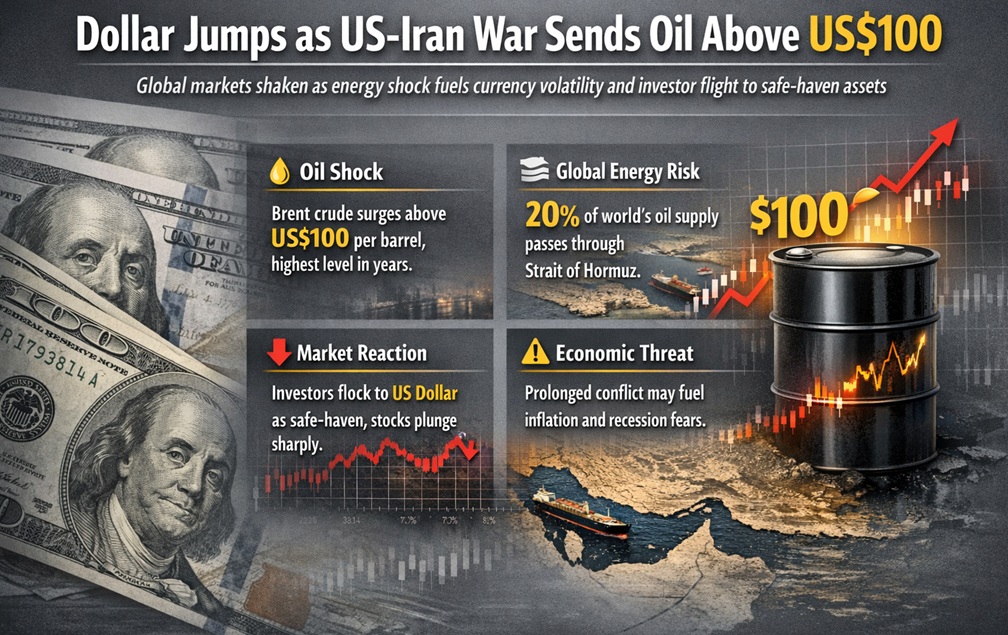
The US dollar surged to its strongest level in three months against the euro on Monday as escalating conflict between the United States and Iran rattled global markets, pushing oil prices above US$100 per barrel and sending investors rushing toward safe-haven assets.
The greenback climbed 0.8% to US$1.1525 against the euro, its highest level since November, while strengthening 0.4% to 158.48 yen during early Asian trading.
The surge in the dollar came as global financial markets reacted to fears that prolonged fighting in the Middle East could severely disrupt energy exports from the Gulf — a development that could drive oil prices significantly higher and slow global economic growth.
Meanwhile, both Brent crude and US crude futures surged past US$108 per barrel, levels high enough to start affecting global economic activity.
Oil Shock Reverberates Through Markets
Analysts say rising oil prices remain the main channel through which geopolitical shocks are spreading across global financial markets.
Bob Savage, head of markets macro strategy at BNY, said the dollar’s strength reflects a pattern similar to the 2022 global energy crisis.
“Oil remains the transmission channel into inflation expectations, rates and currency markets, with the dollar’s resurgence echoing the 2022 energy crisis,” he said.
Markets are now watching closely to determine whether the conflict will remain contained or evolve into a prolonged disruption to global energy supply.
Dollar Emerges as Top Safe-Haven Asset
The US dollar has posted its sharpest weekly rise in 15 months, emerging as the preferred safe-haven asset for investors as other traditionally defensive assets such as gold weakened amid broad profit-taking.
Joe Capurso, head of foreign exchange at Commonwealth Bank, said the dollar’s position as both a safe-haven currency and an energy exporter gives it a structural advantage during geopolitical crises.
“The dollar benefits from its twin status as a safe haven and an energy exporter,” he said.
Capurso added that the war between Iran and the United States could escalate further before any de-escalation occurs.
Risk Currencies Under Pressure
Several global currencies weakened sharply against the dollar.
- The Australian dollar fell 0.7% to US$0.6983
- The New Zealand dollar declined 0.6% to US$0.5860
- British pound sterling slid nearly 0.8% to US$1.3324
Even the Swiss franc, traditionally considered a safe-haven currency, weakened 0.5% against the dollar.
Strait of Hormuz Tensions Threaten Energy Supply
The geopolitical shock intensified after Iran reportedly targeted ships and energy infrastructure around the Strait of Hormuz, one of the world’s most critical energy shipping routes.
The conflict has already disrupted roughly 20% of global crude oil and natural gas supply, raising concerns that the crisis could trigger a major energy shock.
In a warning that has rattled markets, Qatar’s energy minister told the Financial Times that Gulf energy producers may halt exports within weeks if the conflict worsens — a scenario that could push oil prices toward US$150 per barrel.
Inflation and Interest Rate Fears Return
Higher energy prices also risk reigniting global inflation, potentially forcing central banks to delay interest rate cuts.
Although weaker-than-expected US employment data briefly slowed the dollar’s rally last week, the currency resumed its upward momentum as geopolitical risks intensified.
At the same time, US stock markets showed signs of stress, with S&P 500 futures falling 1.6%, reflecting growing investor anxiety over the global economic outlook.
With tensions escalating in the Middle East, analysts warn that financial markets may face continued volatility as investors assess whether the conflict will remain limited — or evolve into a prolonged disruption of global energy supplies.