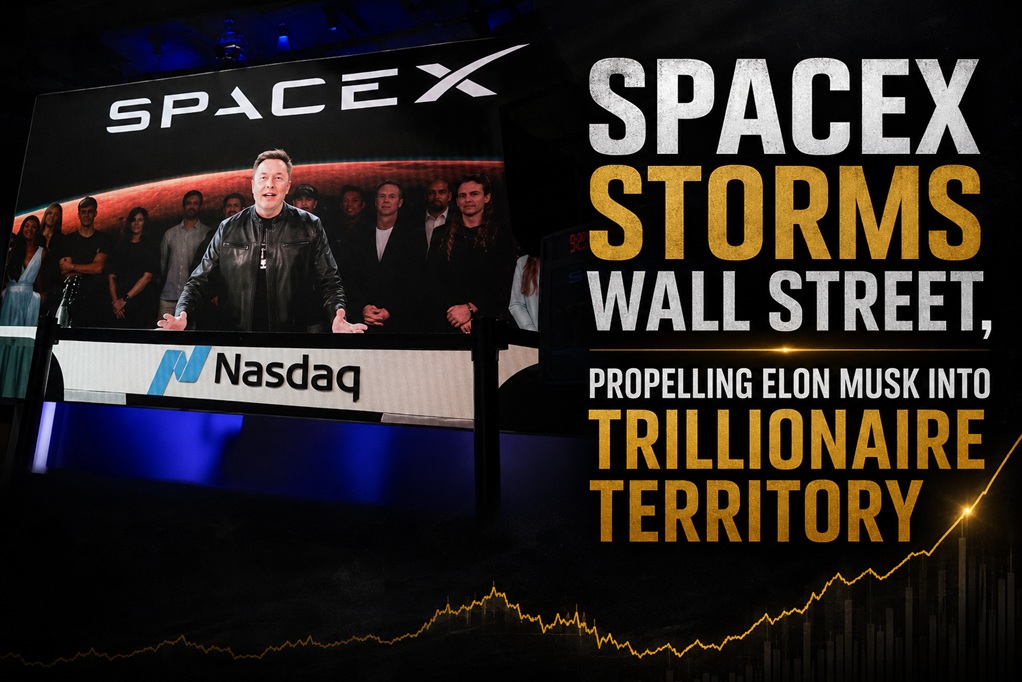
NEW YORK: SpaceX delivered a historic debut on the stock market on Friday, becoming the most valuable company ever to go public and cementing founder Elon Musk’s status as the world’s first trillionaire.
Shares of the aerospace and technology giant began trading on the Nasdaq at US$150, significantly above the indicated offering price, before surging as investor demand intensified throughout the day. The stock closed at US$160, giving SpaceX a market capitalisation of roughly US$2.1 trillion.
The blockbuster listing marks a defining moment for the global capital markets, eclipsing previous initial public offering (IPO) records and reinforcing investor appetite for companies at the intersection of space exploration, artificial intelligence and advanced technology.
Addressing employees before trading commenced, Musk reflected on the company’s journey from a small California startup to one of the world’s most valuable corporations.
“What was once considered impossible is now reality,” he said, reiterating SpaceX’s long-term ambition to establish a permanent human presence beyond Earth.
The company’s stock market debut was celebrated with a symbolic opening bell ceremony at the Nasdaq, while SpaceX simultaneously demonstrated its operational strength by launching another Falcon 9 mission carrying Starlink satellites into orbit.
The successful IPO has dramatically boosted Musk’s personal fortune. As SpaceX’s largest shareholder, the surge in the company’s valuation pushed his estimated net worth beyond US$1 trillion, adding to his substantial holdings in electric vehicle giant Tesla and several other technology ventures.
Analysts say the listing could reshape the investment landscape, particularly as other leading AI-focused companies prepare to enter public markets. SpaceX’s acquisition of artificial intelligence venture xAI has further strengthened its position as a diversified technology powerhouse spanning aerospace, satellite communications, AI and digital platforms.
Despite the enthusiasm, the company faces significant challenges. SpaceX generated US$18.7 billion in revenue last year but remained loss-making as it continued to invest heavily in rocket development, satellite infrastructure, AI computing facilities and future space exploration projects.
Company executives argue that access to public capital markets will accelerate those ambitions, including the development of next-generation spacecraft and eventual missions to establish human settlements beyond Earth.
“Our objective is not simply to build rockets,” the company said in its investor materials. “It is to create the technologies needed to expand humanity’s future beyond a single planet.”
The IPO itself was unconventional. Rather than offering investors a pricing range, SpaceX fixed its share price before trading began, with demand reportedly exceeding available shares by several times. The overwhelming response underscored investor confidence in Musk’s long-term vision despite the company’s ongoing losses.
However, some market observers have urged caution. They point to SpaceX’s aggressive spending, dependence on future technological breakthroughs and concentrated voting control under Musk as potential risks that could contribute to share price volatility.
The company’s rapid inclusion in major investment portfolios could also expose millions of retail investors and pension funds to its performance, making SpaceX an increasingly influential component of global financial markets.
For employees, the public offering has created one of the largest wealth creation events in corporate history. Thousands of current and former staff members are expected to become millionaires through their shareholdings, with many long-serving employees seeing life-changing financial gains.
SpaceX’s record-breaking debut not only redraws the IPO landscape but also signals a new era in which companies built around space technology and artificial intelligence are becoming dominant forces in the global economy.